|
Check out some of the cool ways teachers in our state celebrated the Chinese New Year. Hartsville High School students from Darlington County School District celebrated the Chinese New Year by making traditional decorations and food related to the year of tiger. For decorations, they created 2D & 3D paper-cutting crafts that combined the character of spring and the face of tiger. They also wrote the Spring Festival couplets with the blessing words containing the character of tiger. As one of the most typical food on the Chinese New Year, making dumplings is the students' favorite cultural practice. This year they made the special dumplings with the tiger's colors and stripes. The students shared their decoration works and food with their family and friends to express their best wishes for the year of tiger. Broad River Elementary School in Beaufort County celebrated the Chinese New Year with kindergarten and first grade.
The students learned the stories and traditions on how Chinese people began to prepare the week before the new-year day, and how they celebrated until the Lantern Festival, the 15th day after the new-year day. They also made and presented tiger crafts to welcome the Year of the Tiger and learned to say all the main celebration phrases in Chinese. Lastly, they performed Chinese songs and dances that paid homage to the country's culture and history. THANK YOU, 谢谢/Xièxiè Ms. Zhang Qu for tapping into our children's sense of wonder by sharing the ancient traditions of the Chinese culture.
0 Comments
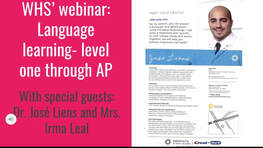
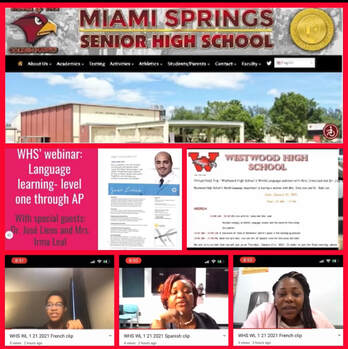
Providing students with authentic language experiences boosts learning, engagement, and builds bridges of personal connection to other people and cultures. Last year, Westwood High school, home of SCFLTA's President-elect, Nadine Okoduwa Stewart, facilitated the following language enrichment activities. Webinar with Dr. José Liens & Mrs. Irma Leal
Virtual Hang Outs with Native Speakers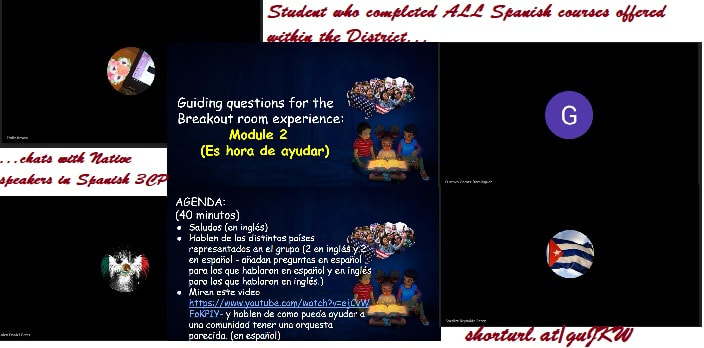 Westwood High's Spanish faculty facilitates virtual hang outs for Honors students not currently enrolled in Spanish (but plan to continue studies in college) in order to practice with native speakers. These hang outs also give native speakers a chance to practice their English. Win-win! Level-up Proficiency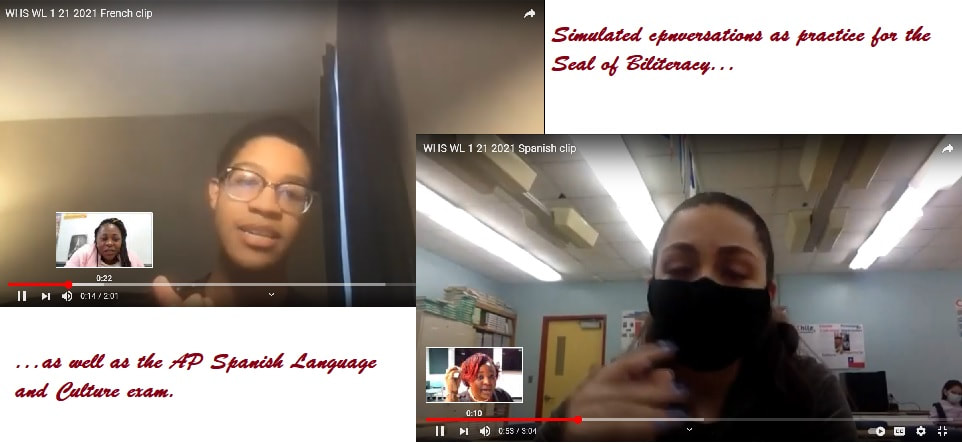 Yearly, the faculty encourages Westwood High School's 11th -12th graders who are bilingual or who have studied at least one other language, to level-up and prove their proficiency in their languages. The State Department of Education provides this opportunity. Students can earn a Gold, Silver, or Bronze Seal of Biliteracy from the State of South Carolina.
There is a lot happening with languages in South Carolina and we would like to share and network with YOU. Whether you are early in your career or experienced, we want to provide an opportunity to connect with other language teachers and share in our collective successes and challenges.
During the first of our virtual social hours we hope to have some fun with a short game or two and then hear from you about what is on your mind and what topics would be of interest for the next social hours. If you can't make it, feel free to share your thoughts in the comments or via Twitter or Facebook. We're looking forward to meeting you! ~ The SCFLTA Regional Reps Julia Royall, Amanda Hajji, Stephanie Madison, and Heather Giles" Here is the Zoom link for the meeting: Join Zoom Meeting https://rockhillschools.zoom.us/j/81859633435?pwd=eVRuZ0VBeXJXRmt1UFRkT1IrYlFOZz09 Meeting ID: 818 5963 3435 Passcode: 956468  Eliciting language learner engagement on a regular basis is complex in any learning setting— face-to-face or virtual. And, as every world language or immersion teacher knows, engaging learners regularly takes paying attention to who they are, their goals, their interests, what the learners bring, and what they need. Careful listening and attention to students is some of the deep work that I see teachers pouring themselves into on the spot during class, after class when examining student work, and asynchronously while watching student work emerge. World language and immersion teachers become masterful at getting a pulse on student goals and needs so that they can help their learners move forward toward increased intercultural competence and language proficiency. There is no single “trick” that can help teachers elicit this engagement in the language and guide learner attention, but we do have many tools at our disposal to help, and I’ve been considering one category of tools lately that tend toward the technical but still require some adaptive thinking based on the students in the (face-to-face or virtual) room. My inquiry: How can some of the technical decisions we make about video help boost student engagement? What are some go-to technical strategies that the instructor/facilitator/creator can use regularly to assist with capturing learners’ attention and keep it? After doing some reading, listening, thinking, and trial runs of my own, here are some ideas that I came up with: Synchronous OR Asynchronous:  Framing Use the purpose to determine what’s in frame. Think about a movie or television show that you have seen. When does the camera show a close-up of someone? When is there more of the person/people/scene in view? When do characters move toward or away from the camera? What objects or scenery do the actors interact with? Thoughtful, well-planned framing decisions can boost the effectiveness of your communication through video, and therefore others’ engagement with it!  Movement, Gestures, Expression Use your face and body. If your whole body appears in frame, use your body— including some very large and deliberate gestures— to help convey meaning (think of an actor on stage who is trying to make sure that even the people in the balcony have a good experience). If you are closer to the camera, you’ll still want to be intentional about your body, gestures, and facial expressions, but some of the more subtle things that you do may be captured, as well.  Lighting Select lighting that will help your students see your eyes and mouth. Facial expressions can go a long way to helping make our input comprehensible when we communicate. A great way to make sure that your face is lit well enough to be visible is to sit in a location where there is (or where you have placed) a light source at roughly a 45 degree angle from your nose (from above, or possibly above and off to the side a little). A lamp can work, but in some cases it may be easier to get a large light source by just using window light. You may also consider sitting in a room that reflects light well from different angles. If you want to take your lighting up a few notches, you may even want to explore ways to diffuse light. This post from FilmDaft (albeit geared toward people who likely have some photography/videography lighting gear) presents some ideas for how to do this with parchment paper. If you do not have specially-designed off-camera lighting gear, a challenge here may be figuring out how to attach diffusing materials safely and in an effective position with regard to your selected light source. Sheer, pale curtains on a tension rod in front of a window is another idea! Asynchronous (recorded in advance for asynchronous viewing): Brevity Condense the time it takes to convey meaning and information. This is certainly not for all videos, but if your video’s main purpose is to convey information or steps, consider condensing it by filming it in different takes, thereby reducing fillers (such as “ums” and unnecessary pauses). It is easy to do this using Flipgrid Shorts without any fancy equipment. Flipgrid even allows you to upload previously recorded clips as part of your video creation -- just make sure the clips aren’t too large in size. Proactive decisions Keep technical snags from getting in the way of viewing. If your video is so large that you have trouble sharing it using common tools (e.g. Flipgrid, Google Drive, etc.), AND/OR if it won’t play all the way through without loading issues, try compressing it: https://www.freeconvert.com/video-compressor These are just some ideas that came to mind as I considered my question for inquiry, but I’m sure you have some great ideas for technical ways to enhance the synchronous or asynchronous video experience, too!
What are some ways that you guide learner attention through video? 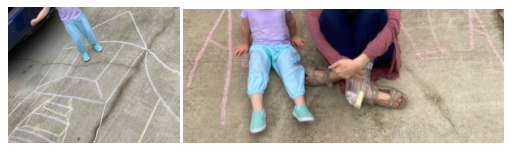 COVID life has surely added new dimensions to planning for learning -- language learning is no exception. Teachers, parents, and coaches in numerous learning landscapes have stretched the bounds of creativity: some guide learners to interact in the target language face-to-face while ensuring increased safety measures such as social distancing, while others engage students in virtual spaces where the cues that advance the give and take of a conversation have had to be relearned. Many do both. In my experience, language educators are unceasingly creative people, but the push to generate new ideas for engagement within a new set of circumstances can be exhausting, even for the most flexible thinker.
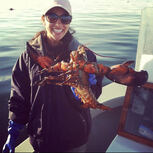
What wells can we draw from to continue moving forward for our learners? If you are a teacher, a parent, or a coach, you may have been on a quest to unearth and vett a new world of resources. Maybe you have joined a virtual professional learning community, or maybe you have made a point to seek out virtual conferences such as SCFLTA, NFLC, and Global Cred. As you continue on your quest, remember that who YOU are is important to the learners that you lift up every day. You experience the world, and your students are experiencing it too. I was reminded of this a month or so ago. My toddler, like many toddlers, likes to be active. We don’t really have a great yard space for her to play in, so I have typically been very grateful for public outdoor spaces. Lately, given that most of the public parks we would visit have closed their playground areas as a health precaution, we’ve had to start thinking outside the box. We do have a driveway, and sidewalk chalk is a favorite activity. One Saturday, when the air started to feel a little cooler, I was out there making sidewalk chalk drawings with my toddler -- stars, circles, pumpkins, simple outlines of animals, a sun and a moon. She looked at me and said, “Mommy, I need a playground.” I reminded her that unfortunately, we’d have to wait on playgrounds for awhile but that we had plenty of other things to do. She said, “No, draw me a playground. Draw me a swing.” I drew a swing set with three swings. She sat down on one and asked me to sit in the one next to it. We sat there for awhile. Then, she said, “Mommy, can you draw me a slide?” I drew a chalk slide. She then informed me that she couldn’t use it without steps to get up to the top, so I had to draw that. She walked to the top, waved to me from the top of my chalk creation, asked me if I would catch her at the bottom, and then (more or less) slid down, jumping onto her feet at the bottom and cheering. This continued for some time -- she told me she needed “a big playground,” and we co-constructed it with her telling me what to draw and where, me drawing it, and her testing the integrity of the pink, blue, and yellow chalk structure. After this impromptu sidewalk chalk extravaganza came to a close (and as I washed her chalk-covered clothes), I reflected on how this child had stretched my mind. It never would have occurred to me to draw a playground for her and ask her to pretend it was real, but it occurred to her. This got me thinking about the creative contributions that students -- and all learners really -- can make in helping us design learning experiences for them. I wondered how I could create space for creative contributions from the people I work with in professional learning groups, and I pondered how student agency can look in different environments. Certainly, it would not always look just like my experience that day, but it got me thinking. My experience with my toddler that Saturday helped me make a connection. It was a kind of resource that added to my learning. Wherever you are, I hope you know just how valuable you are to your students and to the people whose lives you touch and that YOUR experiences doing life are valuable resources to tap into. What life experiences have you drawn from? This week in The Crescent, I have a challenge for you. Take a moment from your day to stop, breathe, and just gaze at the stars. What do you see?  constellation If you are a realist, you may say, “Obviously, I see stars, a night’s sky, some trees, and a constellation”. To my wonderful realists, I cannot deny that truth. You are, in fact, interpreting one correct and very logical answer. However, I challenge everyone: Look again. You may see a BUSINESS TIE or, thinking of the cold winter weather, an ICE SCRAPER FOR YOUR CAR. Step back and take a look from a different angle. You may notice that other stars embellish the formation which starts to look something like this:  "" What do you see now? When I look at this picture, I reflect on my summer as a volunteer for a camp in Maine… What do I see? I see a bunch of claws from my first time hauling for LOBSTER.
My brother, on the other hand, would tilt his head and see the antennas of the EVIL GRASSHOPPER in his favorite childhood movie, A Bug’s Life.
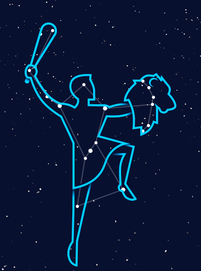
Look again, You may see a WARRIOR WITH HIS ARM RAISED.  What is in his other hand? Is it the HEAD OF A LION, a SHIELD or is he wielding an ARROW?
If you are an astronomer: You may know this to be the constellation Orion, with the three recognizable stars across the center known as “Orion’s belt”. If you are a mythologist: You would tell me that Orion was a celebrated hunter in Greek mythology. If you are a linguist: You would mention one of the stars in Orion’s belt is called “Alnilam” in Arabic, meaning that it is not a belt, but a string of pearls. You may also remind me that in Spanish the three stars of Orion’s belt are called “Las Tres Marias” or, in places like the Philippines and Puerto Rico, “Los Tres Reyes Magos”. “We all look at the same stars and see different things”. Based on your background in Astronomy, the language you speak, the stories from your culture or your past experiences, we all saw different images in the stars. How does this apply to the classroom? Just like we, as teachers, bring our culture and experiences to the classroom, each child brings a set of experiences with them. It is important to understand why students think and feel the way they do, what struggles they have in life and what makes them feel alive. Getting to know students’ experiences builds relationships and encourages student engagement. Most importantly, it expands our knowledge of the world, making us better listeners, better individuals, better educators. How to do it?
Why spend so much time gazing at stars? With new experience and new knowledge, our first glance can change over time to form something more elaborate, more beautiful. Sometimes we need to take a look and then... pause... to look harder. Why spend so much time gazing at the stars? Because, my sweet friends, with time our pupils are able to open to the night’s sky, then, and only then, can we see beauty in the dark and our skies are forever brighter. 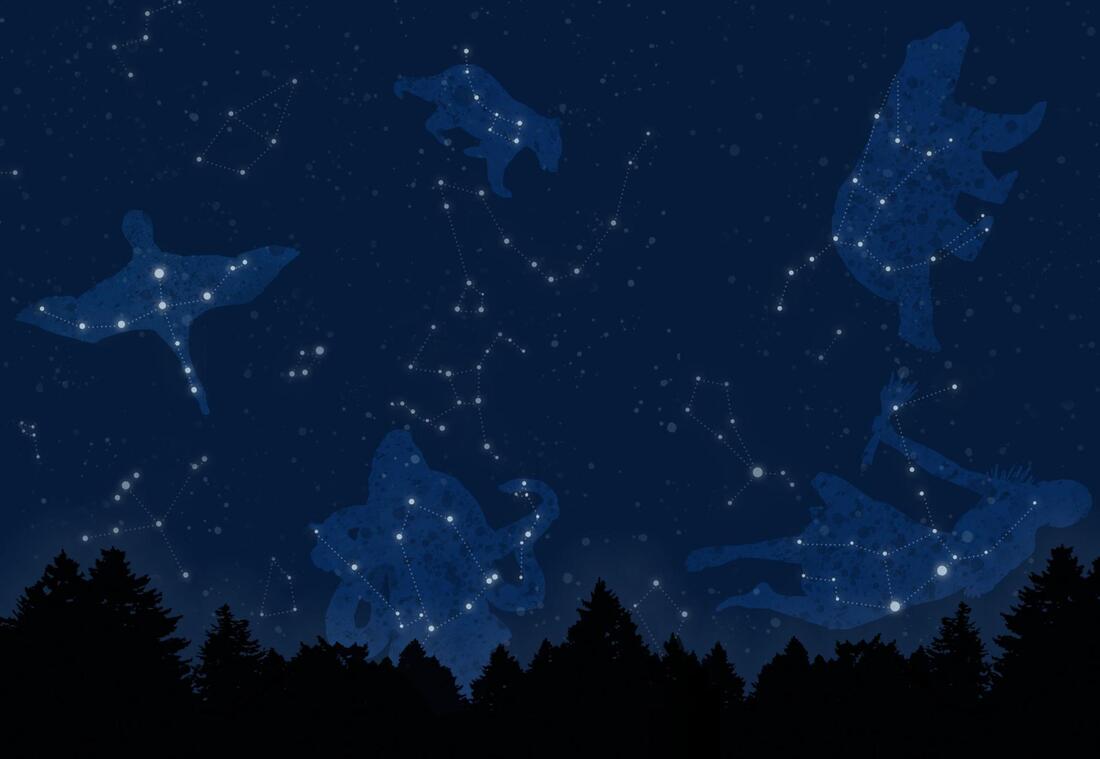 Have you ever felt so overwhelmed that someone else's good news made you feel worse? I have. In fact, at times, I struggle with jealousy, both professional and personal. How does that teacher get so much done in one week? How do others get grades done so quickly? How does that person always look so put together when I just crawled out of bed? Doing work (or workouts) BEFORE school? Oh, how I wish I had the energy others had! Have you ever tried that new activity in your classroom and it failed miserably (the first time)? But you kept on revising and changing it so that it worked better and better the more you tried it? I have! In fact, I have failed many times in my life and career. I try to learn from my mistakes (they be but many) and keep on moving. Yes, I usually have a good cry, and sometimes my recovery time isn't as quick as I'd like, but something inside tells me not to give up because those kids, or now I think, those teachers, are just to important and they deserve another try. We can often be our own worsts critics, talking to ourselves in ways we would never talk to someone else. We beat ourselves up if we make a mistake or if we don't think we compare to others around us. If you are at all like me, you might need to remind yourself that it's okay. We all mess up, we all struggle--that's called learning. While you feel you are struggling, someone else is looking at YOU and wondering how YOU are so awesome and how YOU keep rocking every day. Recognize this feeling when working with students. School makes many students feel like failures, and they get discouraged and don't want to try anymore either. This video is not new, and many of you have probably seen it already, but I encourage you to take the six minutes to watch it again. It is a beautiful example of what listening to feedback and making revisions can do for our kids and for us. So, as we are ending one year and starting the next, please take some time to be proud of how you've grown from the difficult, uncomfortable times in your life. Reflect on the lives you have touched, the smiles you've put on faces, and continue to persevere! Keep going, keep learning, keep teaching and thriving. And remember, while you just might not be where you want to be yet, someone is looking at YOU and wanting to be where you are. This Crescent post will be discussing educational policy. While it may not be as visible in the day-to-day routine of teaching, language policy is the deciding factor in so many aspects that affect our careers as world language educators. Language policies can be the make or break when it comes to funding for classrooms, employment security and, most importantly, deciding student course opportunities. Recently, there has been discussion in legislation that would allow the study of world language to be substituted with computer coding. Below you can find the SCFLTA's official position statement on the matter. "The South Carolina Foreign Language Teachers’ Association (SCFLTA) stands with our national organization, the American Council on the Teaching of Foreign Languages (ACTFL), against any legislation that would allow the study of a world language in the state of South Carolina to be substituted with computer coding". Learn more about being an advocate for world languages here. Please contact your legislators and encourage your network to do the same. It's a quick and easy search from this website. Click Greetings SCFLTA! For the first blog post of the 2019-2020 school year, I am thrilled to be sharing with you tech tips from your very own 2018 SCFLTA Teacher of the Year, Ms. Jessica Kelly! Feel free to comment below and tweet your questions @senorakellylhs ! Don't forget the SCOLT Professional Development Outreach Fund is available to bring your state TOY to your district. You can find more info here. I encourage you to take advantage of it.  Hello world language enthusiasts! It was a whirlwind experience as your SCFLTA 2018 TOY and am so thrilled to have been able to represent such a supportive community of amazing world language teachers! I have been asked to share with you all some of my favorite go-to tech activities for getting students engaged and taking risks with language proficiency while also providing an informal check-in on targeted structures for me. Without further ado, I present to you... GOOSECHASE and INSTACOMMUNITY! Goosechase is an online platform for virtual scavenger hunts where the teacher can create tasks for students to respond with either short videos, pictures or texts to prove successful completion of the task. Pros:
Interactive Activities with SeeSaw I got the idea for this next project when I started making a conscious effort to differentiate for honors level courses. I noticed that my CP students had more fun using the language because they were not as grade oriented, whereas, my honors students were less creative due to fear of making mistakes. I desperately needed a safe space for them to become more confident in the target language and to be willing to take risks. And so, the Instagram project was born. About the Instagram Project: Students assume the role of an Instagram influencer, all within the controlled environment of SeeSaw. They must pick a theme and stick to it the rest of the semester. Using their skills of persuasion and creativity, they must attempt to win over as many followers as possible. Within each curriculum unit, students were provided with a context that they had to adapt an Instagram post for. From there, the class would comment and like each other's posts. For more information about the specific tasks, how to modify it for different levels and different languages (shout out to Latin!) see my SCOLT 2019 Presentation! Thank you so much for taking the time to make it to the end of my ramblings! If you have any questions, please do not hesitate to ask!
Sincerely, Jessica Welcome back to the second post of this summer's series Hot Topics. Last week I asked for guest submissions on how you or your colleagues incorporate technology in the classroom. This week we are highlighting a submission from Aymer Rojas, Spanish teacher in Lexington-Richland District 5 who will be discussing how he uses technology in the elementary classroom. Aymer submitted a beautiful paper that I will link below with research to back the claims. For the blog, I will be highlighting his list of technology, including virtual field trips! Please do take the time to check out his attached essay it has pictures of what these activities look like in the classroom! Using Technology to Engage your World Language Class in Elementary By Aymer Rojas Engaging students can be tough. The high performing students seem like they don't need it and the low performing ones need an extra push to be engaged. In truth, all students can benefit when we transform our classrooms into engaging environments. As Foreign Language teachers, we have a lot of content to teach, but we also have the responsibility to teach our students to be culturally competent and guide them to learn how to respect, be open-minded and enjoy another language. In my twenty years of experience, I continue finding that our students change every year and for that reason, I have created a list of activities and technology tools that my students enjoy. Voki Voki is an educational tool that allows users to create their very own talking character. This tool is created by Oddcast and is located in New York City. Voki characters can be customized to look like historical figures, cartoons, animals, and even yourself! Kahoot! is the oldest of the review games, launched in August of 2013. In a standard Kahoot! game, questions are displayed to students on a projector or display. Students respond on their own devices. At the end of a Kahoot, teachers can download the results. Quizizz takes the excitement of a review game and puts the whole experience in the students’ hands. Everyone sees the question and possible answers on the projector and answer simultaneously. Quizizz is different because the questions and possible answers are displayed individually on student devices. Skype in the classroom I used this technology to connect my students and fellow educators globally. We had collaborative projects where students worked with people in different countries and had virtual field trips. We Skyped a classroom in South America and the result was lots of engagement. The process was very simple and my students had the opportunity to practice Spanish with native speakers with the same age as them. Memes in the classroom Classroom Memes can be used to connect with your students. You can also have some fun exploring the meme generating sites - maybe create one or two with the class. While creating memes can be an exciting process, you need to be cautious as some meme-generating sites can be inappropriate. Virtual Field Trips I have been doing virtual field trips with my third through fifth- grade classes and these have brought fascinating experiences. My students have virtually experienced Angel Falls in Venezuela, Machu Picchu in Peru, and La Sagrada Familia in Barcelona. To further enhance the experience provided by virtual field trips, you can also use 3D goggles. Padlet is another collaboration tool that teachers can use. Students can comment and interact with it as needed. Teachers can monitor all interactions that students have with the content and track engagement analytics. Edpuzzle It is a free assessment-centered tool that allows teachers and students to create interactive online videos by embedding either open-ended or multiple-choice questions, audio notes, audio tracks, or comments on a video. FlipGrid This tool allows to record the students and let then set up and decorate a background. This encourage quiet students to speak their minds without feeling intimidated and practicing their speaking skills. Animoto is a cloud-based video creation service that produces a video from photos, video clips, and music into video slideshows. Spark Video Sis part of the Adobe Spark suite. The application allows students to produce short, animated, narrated videos. Students can easily add photos, voice, as well as sounds to their video creations. |

Editor of
|




 RSS Feed